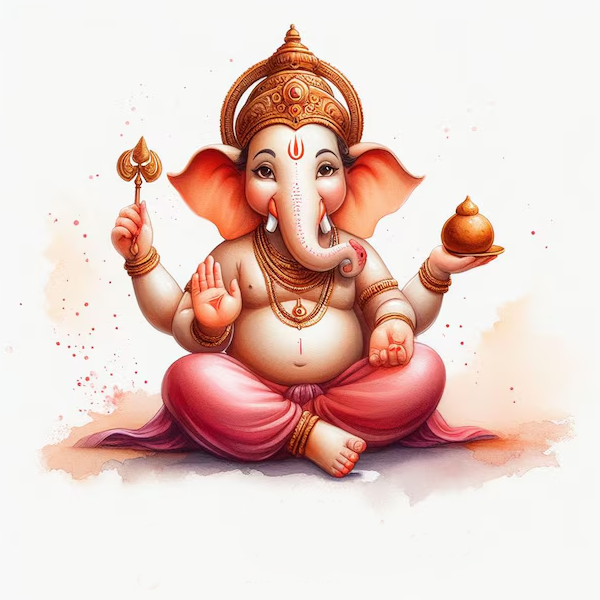
Ganesh Chaturthi also known as Vinayaka Chaturthi is one of the important Hindu festivals celebrated with a great devotion.
As said the day is celebrated as the birthday of Lord Ganesh, the elephant-headed son of Lord Shiva and Goddess Parvati.
Lord Ganesh is the symbol of wisdom, prosperity and good fortune.
Ganesh Chaturthi is celebrated on Shukla Chaturthi of the Hindu month of Bhadra (generally falls between August and September).
This festival is celebrated by Hindus with a great enthusiasm. People bring idols of Lord Ganesh
to their homes and do worship. The duration of this festival varies from 1 day to 11 days, depending on
the place and tradition. On the last day of the festival the idols are taken out in a colorful and musical
procession and immersed traditionally in water.
As per Hindu mythology Lord Ganesh is considered as "Vigana Harta" (one who removes obstacles) and "Buddhi Pradaayaka"
(one who grants intelligence). This festival is very important for students; they worship Lord Ganesh to illumine their minds.
We would like to inform the devotees that the GANESH CHATURTI Celebrations in MIDLANDS will lasts for One whole day (either on the 1st,
3rd, 5th, 7th or 10th day) between Ganesh Chaturthi (1st Day) and Ananta Chaturdasi (10th day).
Who is Ganesha
Ganesh is arguably one of the most beloved and worshiped Hindu deity of all. Being the eldest son of Lord Shiva; the Destroyer,
and his wife Parvati, Ganesh is the God of Wisdom and destroyer of vanity, selfishness, pride and also the
remover of obstacles. Before any undertaking is begun, a prayer to Ganesh is said to ensure success.
Birth of Ganesha
The Hinduism sacred texts give a variety of stories narrating the sequence of Ganesha’s birth, the most popular being the one mentioning that Ganesha was
created by Goddess Parvathi as a guardian to her privacy as depicted in the ancient Hindu text called the "Shiva Purana" which says:
Parvathi while bathing rubbed off the sandalwood paste on her body and out of it created the figure of a young boy. She infused life into the figure and told
him he was her son and should guard the entrance while she bathed.
Meanwhile Shiva came to see Parvathi but the young boy blocked his way and would not let him in. Shiva, unaware that this was his son,
struck off the boys head in rage. Parvathi, returning from her bath, saw her headless son threatened in her rage to destroy the heavens and the earth,
so great was her sorrow.
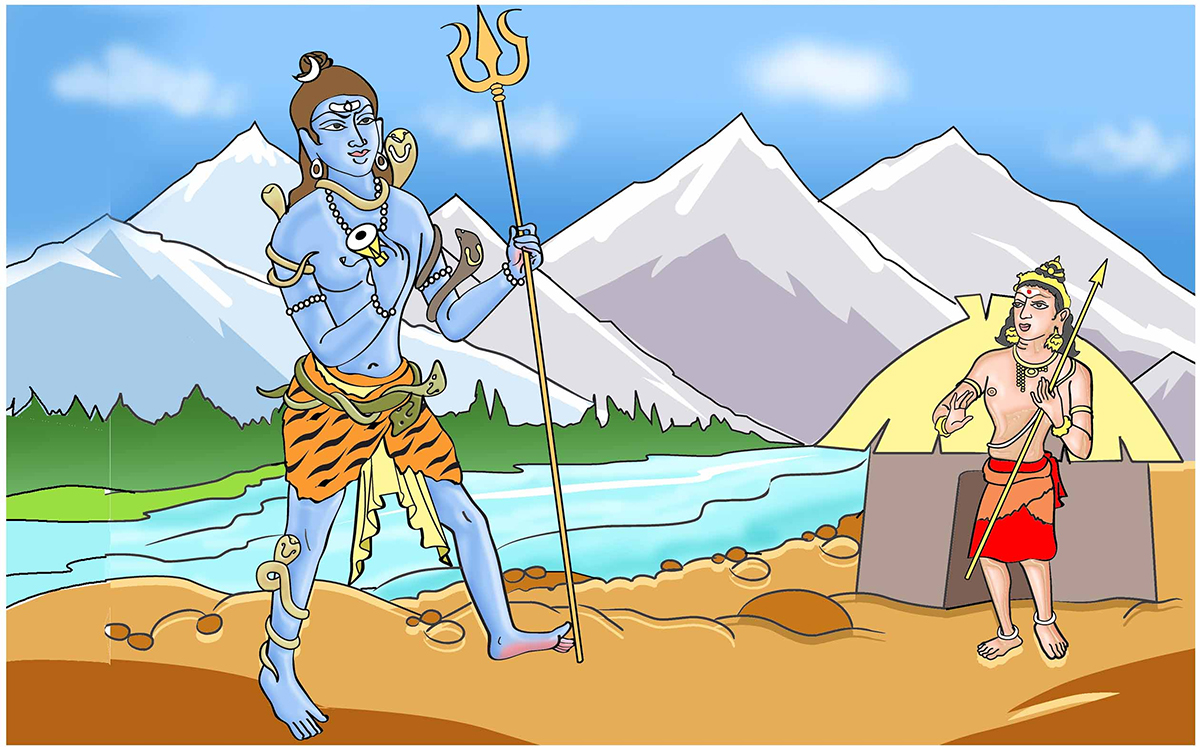
Shiva pacified her and instructed his ganas to bring the head of the first living and north facing being they encounter.
They found a sleeping elephant and brought back its severed head, which was then attached to the body of the boy and breathed life into him.
Shiva has given the name Ganesha to his son and made him the leader of his ganas, hence his name "Ganapati".
Shiva also bestowed a boon that people would worship him and invoke his name before
undertaking any venture. Shiva further blessed the boy, decreeing that all shall pray to Ganesh before enlisting any undertaking.
Significance of Ganesha’s form
Ganesha is usually depicted either as a pictograph or as an idol with the body of a man and the head of an elephant,
with four arms and having only one tusk, the other tusk appearing broken. On his waist, is his sacred thread, often in the form of a snake.
The vehicle of Ganesha is the mouse, often seen paying obeisance to his lord. In essence Ganesha is the personification of material universe
in all its various magnificent manifestations and symbol of abundance.. >
-
The head of Ganesh represents the Atma (the soul or ultimate reality), while his body signifies the world and earthly realm of human beings.
- His fan-like ears convey that he is all ears to our petitions.
- The elephant trunk had the symbol of OM on it, which is the primal sound and symbol of the Universal reality.
- In three of his hands he holds various objects that are symbolic tools for enlightenment: a pasam or rope, goad or axe, and a bowl of rice of or a sweet dessert ball.
The pasam or rope has three braids, each braid representing a different cautionary lesson: arrogance,
Maya or the illusionary nature of the world, and ignorance.
The goad is a staff used to herd elephants and reminds the devotee to steer clear of a self-defeating path, while the axe represents
the ability to cut unhealthy attachment to the material world.
The rice or sweet dessert represents the reward, or the sweetness of living in enlightenment, and the fullness of wisdom.
It promises happiness in return for devotion.
Ganesh’s fourth hand is always free, palm extended in a blessing.
- The snake that runs round his waist represents energy in all forms and also remind us Ganesha is Shiva’s son.
-
Ganesha’s vehicle is a mouse, representing not only how much importance a wise man gives to the tiniest of creatures,
but also agility and resourcefulness.
Utsav (The Celebration) – AM
We welcome and expect the whole community in and around MIDLANDS to come and worship the preventer of obstacles; as the celebration in MIDLANDS
provides an opportunity to participate in Pooja, Bhajans, Performances, Auction, Procession, Immersion etc.
The day of celebration usually starts at 9am and will go on till 6pm. With a common view and to ensure that an enthusiastic spiritual atmosphere
prevails throughout the celebration and the day begins with placing the Ganesha idol on a raised platform in an elaborately
decorated manner for people to view and pay their homage.
(A life-like eco-friendly model of Lord Ganesha is made to order by an experienced idol making community in India 3-4 months prior to the day
of Ganesh Chaturthi celebrations in Birmingham. Once the idol is prepared, It is then carefully exported to us in
Birmingham. The size of the idol usually varies between 3-5 feet.)
We then start the Vinayaka Chavithi vrata sankalpam with the priest invoking life into the idol amidst the chanting of mantras.
This ritual is called ‘Praana Pratishta’.
After this the ‘shhodashopachara’ (16 ways of paying tribute) follows. Coconut, Jaggery, 21 ‘modakas’ (rice flour preparation), 21 ‘durva’ (trefoil) blades
and red flowers are offered. The idol is anointed with red unguent or sandal paste (rakta chandan).
Throughout the celebration, Vedic hymns from the Rig Veda and Ganapati Atharva Shirsha Upanishad, and Ganesha stotra from the Narada Purana are chanted.
Haarathi is offered to the Lord throughout the day at regular intervals.
(The Celebration) – PM
As we all know that ‘Annam Para Brahma Swarupam’. Food only can support the body to attain Dharma, Artha, Kamaand Moksha.
The person, who participates and has food in a divine environment, is considered to be blessed by divine Gods.
So we offer Annadanam as lunch to all the participants during the celebration.
Annadanam is followed by various performances from Bhajans to Singing to Dancing or even some devotional talk.
Evening kicks off with the auction of Lord Ganesha’s Laddu.
"Many consider the auction as a financial exercise but we, LORD MAHAGANAPATHI USTAV COMMITTEE look at it as a means to serve people,"
The idea was not to make money but to do something for the Ganesh Chaturthi celebrations. While, the successful bidders are blessed
with prosperity, the Ganesh Utsav Samithi utilises every penny gained out of the auction for making the celebration better.
Lord Ganesha is known for bestowing prosperity and this is what the Lord’s laddu has done with different people for the past few years. The laddu auction has
now become synonymous with the Ganesh Chaturthi celebrations. While some consider it as a blessing of the Lord of Beginnings,
others look at it as a sentiment.
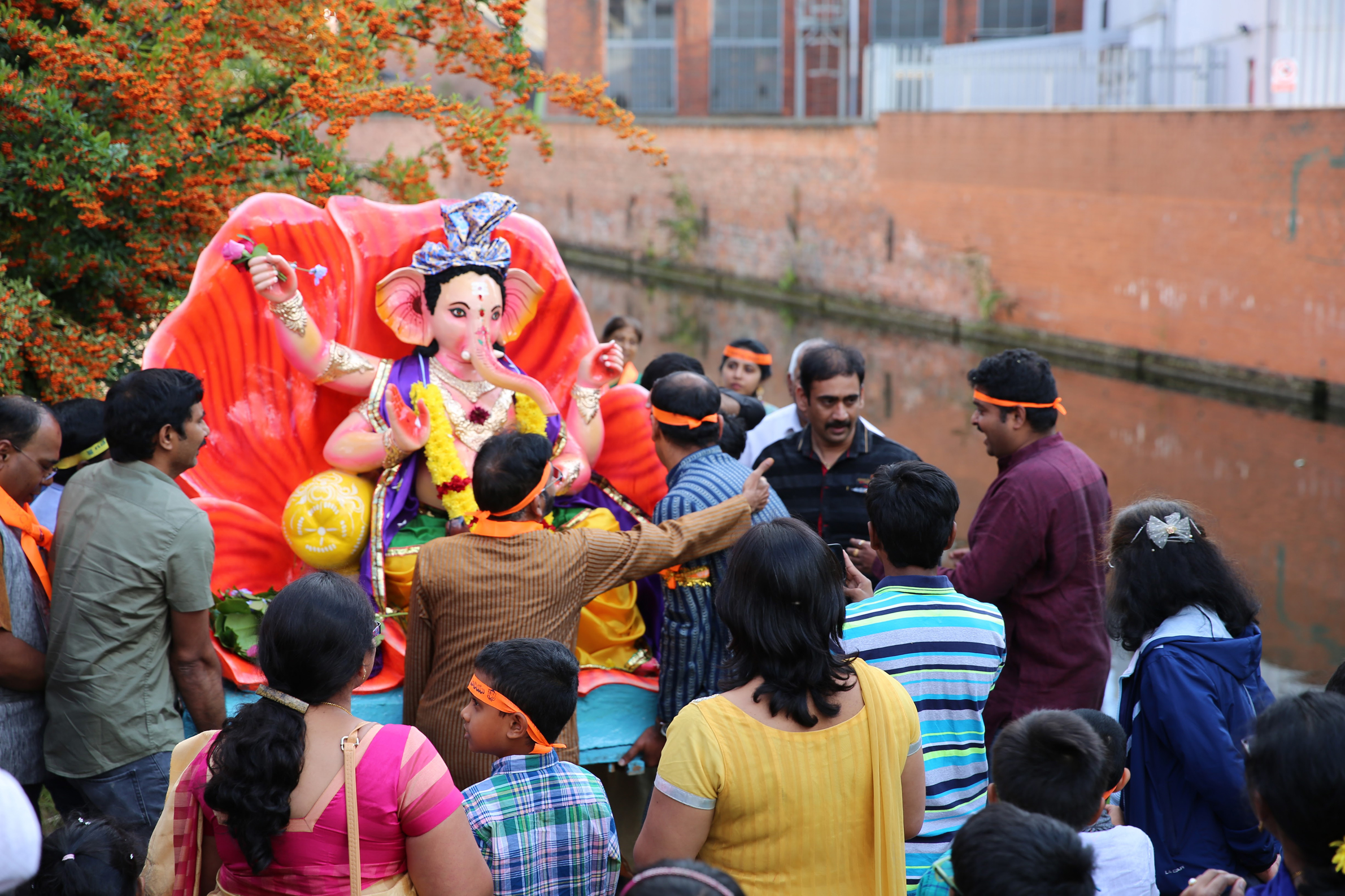
After the Laddu auction, Lord Ganesh is offered prayers and the Ganesha idol is taken through the BIRMINGHAM streets in a procession accompanied with chanting,
dancing, singing etc to be immersed in a nearby lake symbolizing a ritual see-off of the Lord in his journey towards his abode
in Kailash while taking away with him the misfortunes of all of us.
We welcome all the devotees to join in this final procession shouting "Ganapathi Bappa Morya, Purchya Varshi Laukariya"
(O father Ganesha, come again early next year). After the final offering of coconuts, flowers and camphor is given,
idol is carried to the lake and immersed.